Why Simple Lead Forms Matter More Than You Think
Author: Chris Budzban
Posted on: February 2, 2026
For many small businesses, a website’s primary job is simple: generate leads.
Whether that means contact requests, quote submissions, or consultation bookings, your lead form is often the final step between a visitor and a potential customer. Yet one of the most common mistakes we see is businesses making that step harder than it needs to be.
When it comes to lead forms, simpler almost always performs better.
Why Lead Forms Are So Important
Your lead form is the bridge between interest and action. Visitors may:
- like your services
- trust your brand
- be ready to reach out
…but if your form feels overwhelming, confusing, or intrusive, many will leave without submitting anything.
A well-designed lead form should:
- feel easy and low-pressure
- take only a few moments to complete
- clearly communicate what happens next
The Problem With Overcomplicated Forms
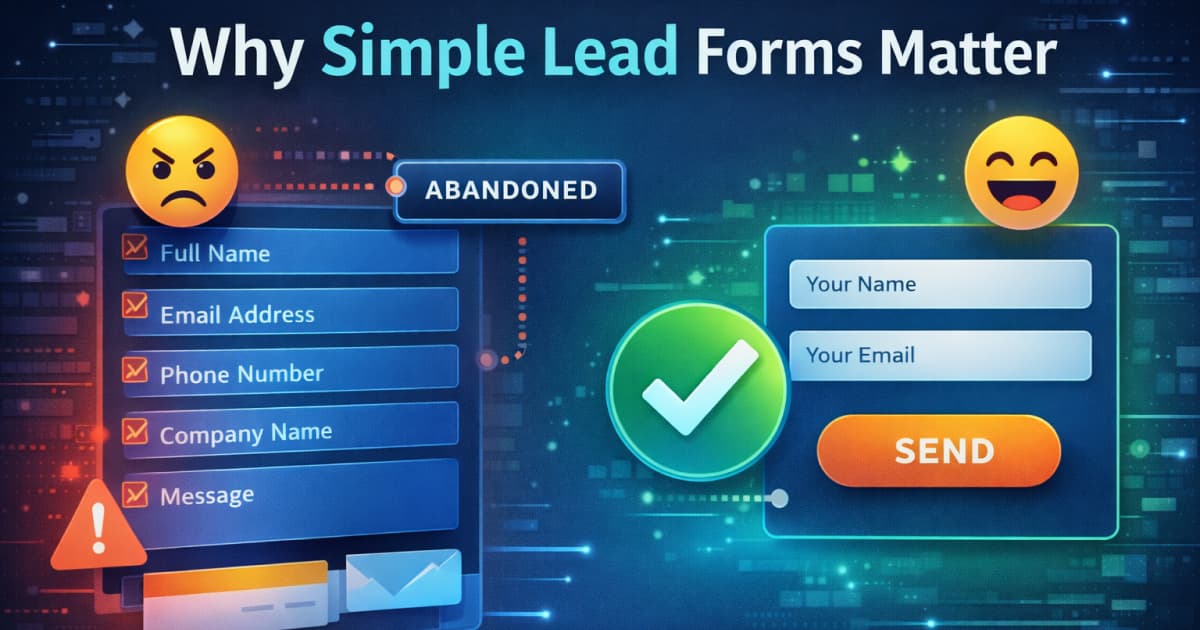
Many businesses try to collect too much information up front, asking for:
- long message fields
- detailed project requirements
- budgets, timelines, and company size
- multiple dropdowns and checkboxes
While this information may be useful eventually, it often kills conversions.
Common issues with complex forms include:
- visitors abandoning the form halfway through
- hesitation due to privacy concerns
- mobile users struggling with long inputs
- decision fatigue from too many questions
In most cases, people just want to start the conversation — not fill out a questionnaire.
Why Simple Forms Convert Better
Simple lead forms work because they reduce friction.
By asking only for essential information (usually name, email, and a brief message), you:
- lower the barrier to entry
- make the form feel approachable
- increase completion rates
- get more total inquiries
You can always gather additional details after that first contact.
Mobile Users Demand Simplicity
A large percentage of website traffic comes from mobile devices. Long forms that may feel manageable on desktop quickly become frustrating on a phone.
Simple forms:
- load faster
- are easier to tap and scroll
- reduce typing on small screens
- improve overall user experience
Google also factors usability into rankings, so better forms can indirectly help SEO as well.
Trust and Privacy Matter
Visitors are increasingly cautious about how their information is used. Asking for minimal data helps build trust.
Clear, simple forms signal:
- professionalism
- respect for the user’s time
- transparency
Adding a short line like “We’ll only use your information to respond to your request” can further increase confidence.
How Feldspar Creative Designs Lead Forms That Work
At Feldspar Creative, we design lead forms with conversion in mind — not just appearance.
Our approach focuses on:
- asking only what’s truly necessary
- clean, distraction-free layouts
- fast loading and mobile-friendly design
- clear calls to action
- accessibility best practices
We also ensure forms integrate properly with email, CRM tools, or analytics so you never miss an inquiry.
More Leads Start With Fewer Fields
If your website isn’t generating the leads you expect, your form may be part of the problem.
Simplifying your lead form is one of the easiest, most cost-effective ways to improve conversions — without increasing traffic or ad spend.
If you’d like help optimizing your website’s contact or quote forms, Feldspar Creative would be happy to help.
👉 Get in touch and let’s make your website work harder for your business.